Pre-application advice lets you ask the council what it thinks of a proposal before you apply. It can save a refusal on a difficult scheme, but for many straightforward extensions it adds cost and delay without telling you much you could not find out another way.
In this guide, we explain what pre-application advice involves, its limitations, and when we think it is worth paying for.
What Is Pre-Application Advice?
Most local planning authorities offer a paid service in which a planning officer reviews a proposal before a formal application is submitted. You send drawings and a short description, and the council replies with its view on whether the scheme is likely to be acceptable and what changes might improve it.
Depending on the council and the size of the project, the service may be a written response only, or a written response with a meeting or site visit. Larger schemes may also involve specialist officers, such as conservation or highways officers.
Fees and the level of service vary widely between councils, and some offer only a limited service for householder projects, or none at all. Check the current charges and response times on your council’s website before deciding.
The Limitations of Pre-Application Advice
It is not binding
Pre-application advice is the informal view of an officer. It does not guarantee planning permission. When the formal application is submitted, the council must still consult neighbours and other consultees, and objections can raise issues the pre-application response did not consider.
Councils also usually state that the advice is given without prejudice to the final decision, and the application may be assessed by a different officer, or decided by a planning committee.
It adds time
A pre-application response often takes several weeks, and sometimes longer when a council is busy. Because a householder planning application itself has a target decision period of eight weeks, pre-application advice can noticeably extend the overall programme.
It is often cautious
Officers giving pre-application advice tend to apply the council’s design guidance closely and can be more cautious than the eventual decision. A response that asks for a smaller or simpler scheme does not necessarily mean the original proposal would have been refused, particularly where there are similar extensions nearby.
It costs money twice
Drawings still need to be prepared for the pre-application submission, and they will usually be revised afterwards. The council’s fee for the advice is also separate from the planning application fee.
When Pre-Application Advice Is Worthwhile
In our experience, pre-application advice is most useful where there is genuine uncertainty that cannot be resolved by reading the council’s policies or looking at previous decisions. For example:
- Listed buildings and sensitive conservation areas. The view of the council’s conservation officer can be decisive, and it is useful to know it before the design is fixed. See our guide to planning permission in conservation areas.
- New dwellings and conversions to flats. These involve more policies, such as space standards, amenity space, parking and refuse storage, and the cost of a refusal is much higher.
- Schemes that go beyond the council’s guidance. Where a proposal exceeds the normal limits, such as an extension deeper than the council’s guidance allows, an officer’s early view can indicate whether the justification is likely to be accepted.
- Sites with a refusal or difficult planning history. Advice can help establish whether a revised scheme overcomes the earlier reasons for refusal. See our guide on what to do when planning permission is refused.
- Unusual designs. Contemporary or unconventional designs that do not follow established patterns can benefit from early discussion.
When It Is Usually Not Needed
For many common householder projects, the likely outcome can be judged from the council’s design guidance and from similar extensions recently approved on the same street. This often applies to:
- Single-storey rear and side return extensions that follow the council’s guidance.
- Rear dormer and hip-to-gable loft conversions where similar conversions exist nearby.
- Projects that are permitted development, where a Lawful Development Certificate is the appropriate route instead.
In these cases, submitting a well-prepared planning application is often quicker. If the officer has concerns during the application, they may ask for amendments, and if it is refused, the refusal reasons give clear direction for a revised scheme. Many councils also allow a free resubmission of a revised householder application within a set period after a refusal.
Alternatives to Formal Pre-Application Advice
- Research previous decisions. The council’s online planning register shows approvals and refusals for neighbouring properties, along with the officer reports explaining them.
- Read the council’s design guidance. Most London boroughs publish guidance on extensions and roof alterations. See our borough-by-borough guide to local planning policy.
- Use an experienced designer. Someone who regularly submits applications to your council will usually know what it tends to accept and how to present the scheme.
- Talk to your neighbours. Many refusals and delays stem from objections. See can neighbours object to my planning application?
Getting the Most from Pre-Application Advice
If you decide to seek advice, make the submission count:
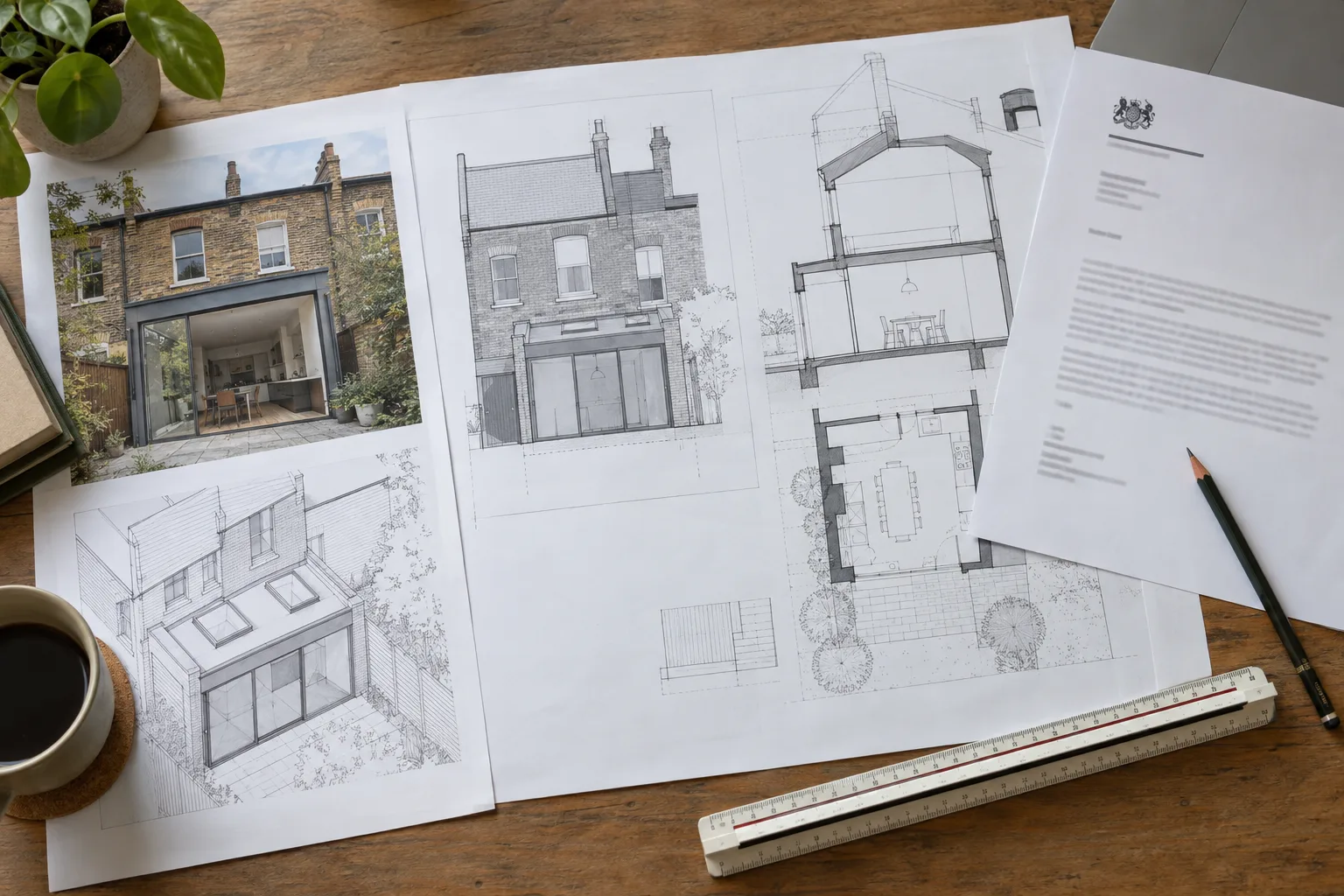
- Submit clear, scaled drawings based on an accurate measured survey, so the officer is commenting on the real scheme.
- Ask specific questions about the points you are unsure of, rather than asking whether the scheme is acceptable in general.
- Include photographs and examples of similar approved extensions nearby.
- Where there is a choice, consider whether a meeting or site visit is worth the extra fee for a sensitive site.
So, Is Pre-Application Advice Worthwhile?
For complex, sensitive or high-value schemes, pre-application advice can be a sound investment. For most straightforward house extensions and loft conversions, it is often better to research the council’s guidance and previous decisions carefully and submit a well-prepared planning application.
For more on why applications fail, see our article on common reasons planning permission is refused.
How Draw & Plan Can Help
Draw & Plan prepares measured surveys, planning drawings and Building Regulations drawings for house extensions, loft conversions and conversions across London. Before quoting, we review your property’s planning constraints and history, and we can advise whether pre-application advice is likely to be worthwhile for your project.
This article provides general guidance. Pre-application services, fees and response times vary between councils and change over time, so check your council’s current arrangements before applying.
Disclaimer: This article is for general informational purposes only and does not constitute legal or professional advice. Always consult relevant professionals and local authorities before undertaking any development or change of use.